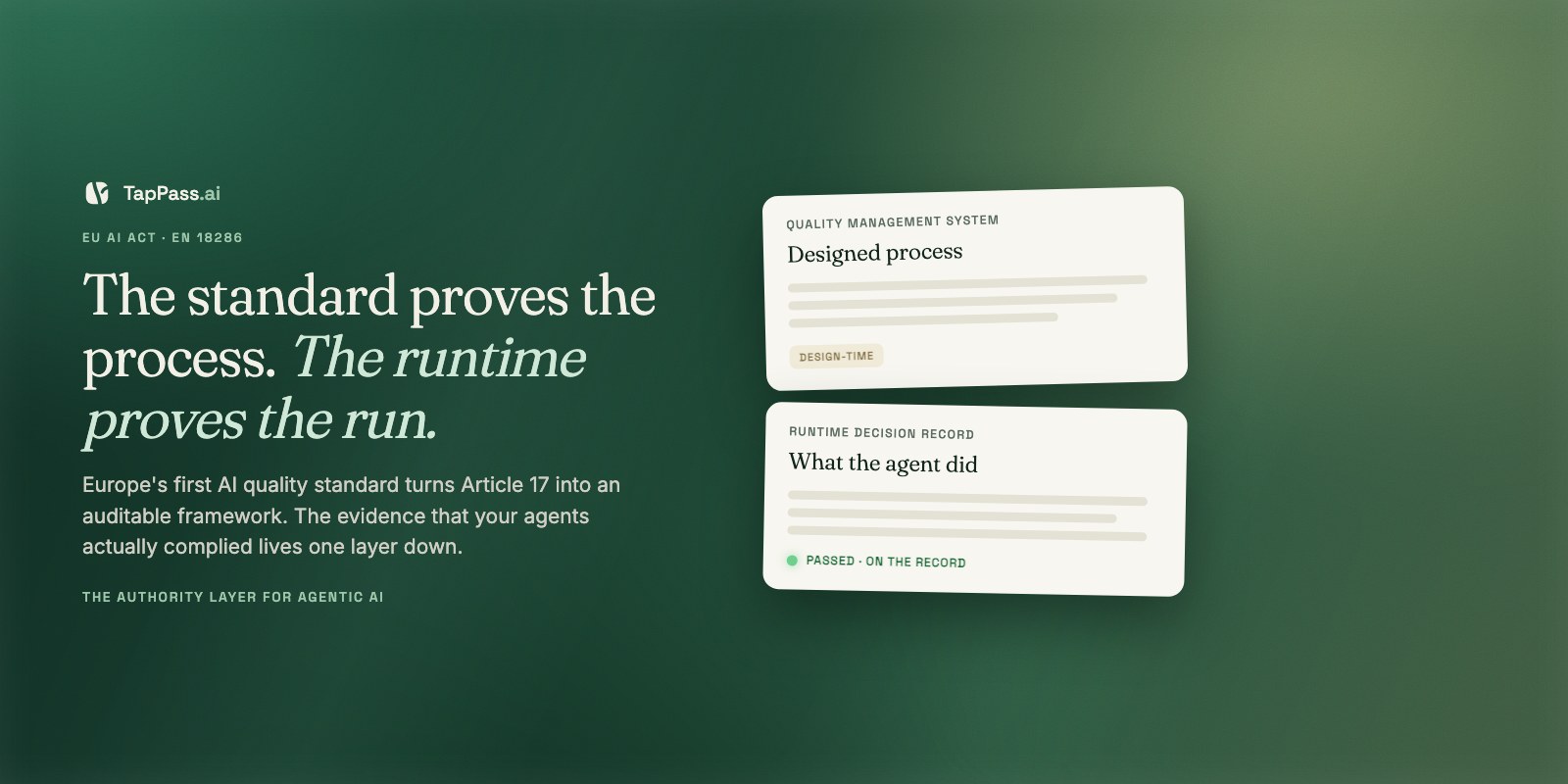
On July 31, 2026, CEN-CENELEC published EN 18286, the first European standard written specifically to support conformity with the EU AI Act. Its full title is “Artificial intelligence. Quality management system for EU AI Act regulatory purposes”, and it does something the Act itself could not: it turns Article 17, a single paragraph of legal text, into an auditable framework an organisation can actually implement.
This matters, and it is worth understanding what the standard gives you. It is also worth being precise about what a quality management system is for, because the gap between what it certifies and what an AI Act audit actually asks for is exactly where most deployments will be caught short.
What EN 18286 actually is
EN 18286 is a quality management system standard. If you have worked with ISO 9001, the shape is familiar: it sets requirements for how an organisation governs a process, documents it, keeps records, assigns responsibility, and improves over time. What EN 18286 does is adapt that management-system discipline to the specific obligations the AI Act places on providers of high-risk AI systems. It is sector-agnostic, and it gives you a concrete framework for governance, life-cycle control, documentation, and consistency.
The reason it is significant is not the content alone. It is the legal mechanism behind it. EN 18286 is a harmonised standard, developed under the European Commission's standardisation request for the AI Act. Once a harmonised standard's reference is cited in the Official Journal of the EU, conforming to it gives a provider a presumption of conformity with the corresponding legal requirements. In plain terms: follow the standard, and you are presumed to satisfy Article 17 unless a regulator shows otherwise. That is the clearest route the Act has yet offered from legal text to defensible practice, and until now it did not exist.
A provider of a high-risk AI system must operate a documented quality management system covering, among other things: a regulatory compliance strategy, design and development controls, testing and validation procedures, data management, the risk management system of Article 9, post-market monitoring under Article 72, serious-incident reporting under Article 73, record-keeping, resource management, and an accountability framework.
Read that list again and notice what it is. Article 17 is a meta-obligation. Most of its clauses are pointers to other obligations: risk management, data governance, logging, human oversight, monitoring, incident reporting. The quality management system is the connective tissue that ties them into one governed process. EN 18286 is the standard that finally describes what that tissue should look like.
Why this is good news, precisely
For anyone responsible for an AI Act programme, a harmonised QMS standard removes a genuine source of paralysis. Until it existed, “implement Article 17” was a reading exercise. Two competent teams could interpret the same paragraph into two different control sets, and neither could be sure a regulator would agree. A cited standard collapses that ambiguity. It gives you a checklist, an audit basis, and a common language with your notified body and your board.
It also does something quieter that is easy to underrate: it makes the obligation citable inside your own organisation. “We should probably document our AI processes” is a request that loses every budget argument. “EN 18286 clause X requires a documented procedure for Y, and it is the route to presumption of conformity with Article 17” is a request that wins them. The standard is leverage.
The part it can't enforce
Here is the distinction that decides whether a programme built on EN 18286 actually holds up.
A quality management system certifies the process. It proves that you designed the right procedure, wrote it down, assigned an owner, and can show an auditor the document. What it does not do, and by construction cannot do, is prove that a specific agent, on a specific request, at a specific moment, actually behaved the way the procedure says it should. A QMS is a design-time and process-time assurance. It is a statement about intent and structure. It is not a record of what happened.
A quality management system proves you designed the right process. It does not prove your agents ran it. The binder is not the evidence. The decision is.
For traditional software this gap is narrow, because the system does the same thing every time and a process audit is a fair proxy for behaviour. For AI agents the gap is wide and it is where the risk lives. An agent's behaviour is not fixed by its documentation. It shifts with the prompt, the retrieved context, the tool permissions in force that day, and the model version underneath it, which the provider can change without telling you. You can have an immaculate, fully conformant quality management system and still have an agent that leaked data on Tuesday, because the QMS governs how you built and maintain the system, not what the system did at 15:04.
Where the paper meets the runtime
The clearest way to see the gap is to walk the clauses of Article 17 that only become real at runtime, and ask what actually satisfies them.
Record-keeping and logging (Article 12). The QMS requires you to have a record-keeping procedure. The Act requires the high-risk system to automatically record events over its lifetime. A documented procedure is not a log. Something has to produce the per-decision record, and that something is not the management system, it is the runtime.
Post-market monitoring (Article 72). The QMS requires a monitoring plan. Monitoring is a live activity against live behaviour. A plan describes what you intend to watch. It does not watch anything. The evidence that monitoring worked is a stream of observations, produced continuously, not a policy that says monitoring will occur.
Human oversight (Article 14). The QMS requires you to design oversight mechanisms. Whether a human actually had the ability to intervene, was presented with the right information, and did or did not act, is a fact about each decision. It is provable only if each decision carries the record of the oversight that applied to it.
Serious-incident reporting (Article 73). The QMS requires an incident procedure. But you cannot report the scope of an incident you cannot reconstruct. Detecting that an agent misbehaved, and bounding which requests were affected, is a runtime evidence problem. We wrote about this exact failure in the context of the 72-hour clock for an AI incident: the procedure is necessary and useless without the record it assumes you already have.
In every case the QMS documents the obligation and delegates the proof. The proof is a per-decision, queryable, tamper-evident record of what each agent actually did, under which policy, on whose behalf. That artefact is not something a management system produces. It is something a runtime either produces or does not.
What to do with EN 18286 now
Treat the standard as a map of obligations, not a finish line. Concretely:
- Adopt EN 18286 as the backbone of your Article 17 programme. The presumption of conformity is real value and there is no reason to reinvent the structure.
- For every clause that references runtime behaviour, records, monitoring, oversight, incident detection, ask one question: what system actually produces this evidence, per decision, and can we query it under time pressure?
- Separate your artefacts explicitly. Design-time artefacts are policies, model cards, and DPIAs. Runtime evidence is the per-decision record. An audit or an incident asks for both. Most teams have built only the first.
- Make the runtime record reproducible and tamper-evident, so that when you cite a number it comes from a sealed record anyone can re-run, not a spreadsheet someone assembled by hand.
- Use the standard as leverage with your board. The obligation is now concrete, citable, and tied to a presumption of conformity. That is the argument that funds the runtime layer.
The part worth internalising
A harmonised quality management standard is a milestone, and the teams that adopt EN 18286 early will be in a stronger position than the ones still arguing about interpretation. It tells you what good governance looks like on paper, and for the first time it makes that picture official.
The remaining question is the one that decides whether you pass an audit or survive an incident: does the run match the paper. A management system cannot answer that, because it was never designed to. It governs the process, and the process is a claim about intent. Whether the agent honoured the claim on any given request is a fact, and facts need records. That layer is either already there, producing a defensible account of every decision as it happens, or it is not, and you find out which during the one week it matters.